
Young People Are Fed Up
But They're the Best Hope for Reviving Democracy

Around the world, young people are fed up—not with one party or leader, but with political systems they believe are failing them. From Madagascar to Nepal, Kenya to Peru, they are rejecting a status quo that feels corrupt, stagnant, and economically exclusionary. Their anger is not defined by ideology. Rather, it’s defined by a distrust and growing skepticism of institutions.
In the United States, a similar frustration among young people is building. But much of the commentary about Gen Z in the United States—loosely defined as those born between 1997 and 2012—often misses the point. Pundits, analysts, and politicians have been debating whether young voters are drifting left or right, whether young men are becoming more conservative, or whether social media is warping their political views. These questions assume that ideology is the main story. It isn’t.
The defining political shift among young Americans is not partisan realignment, it is collapsing faith in democratic institutions. Gen Z is not simply becoming more progressive or more conservative. It is becoming more skeptical that government as currently structured—and by proxy, democracy itself—works. And that skepticism may be one of the most consequential political developments of our time.
In countries around the world, fueled by anger towards institutions and leaders, young people are taking action. Will their counterparts in the United States do the same? At least two pathways are possible. Young Americans may channel their distrust into rebuilding democratic institutions that better respond to their generation’s economic and social realities. Or their frustration might harden into disengagement, tolerance for political violence, and even openness to authoritarian alternatives. Gen Z will reshape the future of American democracy: the question is how.
American Youth are Frustrated
Gen Z is coming of age amid historically turbulent times. In the United States, most young people have never known a political landscape without Donald Trump and the rancor that has accompanied his rise. Unlike earlier generations, Gen Z has not experienced a unifying national political moment or narrative such as the immediate aftermath of 9/11 (which was itself short-lived and followed by deep division). Instead, they have been shaped primarily by events that entrenched polarization and eroded trust in institutions.
Young people in the United States and abroad were profoundly affected by the COVID-19 pandemic, which disrupted years of schooling and social development. And now another disruption looms: the rapid emergence of artificial intelligence—already displacing jobs and reshaping labor markets—has created deep uncertainty about whether the future of work will function for them at all.
For example, according to a Spring 2025 Harvard Institute of Politics poll, only 19 percent of Americans aged 18-29 trust the federal government to do the right thing. Just 18 percent trust Congress, 23 percent trust the president, and 29 percent trust the Supreme Court. Only 11 percent believe the country is generally heading in the right direction (while this poll focused on young people specifically, other recent polls have demonstrated that generally, approximately 30-35% of all Americans think the country is moving in the right direction).
To some extent, this distrust in institutions predates the reelection of Donald Trump: a 2023 survey by the American Public Media Research Lab found that only 27 percent of Americans aged 18 to 25 strongly agreed that democracy is the best system of government, compared with 48 percent across all other age groups.
Polling we recently conducted at Johns Hopkins University adds more evidence for growing institutional distrust. When asked about the design and structure of the US government, over 60 percent of Gen Z respondents said it needs significant change regardless of who is elected—compared with 46 percent of Baby Boomers who said the same. While 64 percent of Baby Boomers and 55 percent of Gen X respondents felt their political party was moving in the right direction, only 42 percent of Gen Z respondents agreed.
More troublingly, this distrust in institutions has begun to lead to greater tolerance for political violence. Only 11 percent of Baby Boomers and 14 percent of Gen X respondents believe using violence to advance political goals can be justified. Among Gen Z, 40 percent said violence could be justified to some degree.
These figures are alarming—and historically aberrational. Young Americans’ trust in institutions is lower than that of older adults today, and lower than that of previous generations when they were young. This pattern spans social trust, political trust, and confidence in core institutions—and it will shape the future of democracy.
Around the World, Young People are Taking Action
This growing skepticism of institutions and democracy extends well beyond the United States. In a recent Open Society Barometer survey of 36,000 respondents across 30 countries, 35 percent of people aged 18-35 indicated a preference for a strong leader who dispenses with legislatures and elections altogether (compared to 26 percent for respondents aged 56 and above). Alarmingly, 42 percent of people 18-35 believed military rule could be a good way of governing (compared to 20 percent of respondents aged 56 and above).
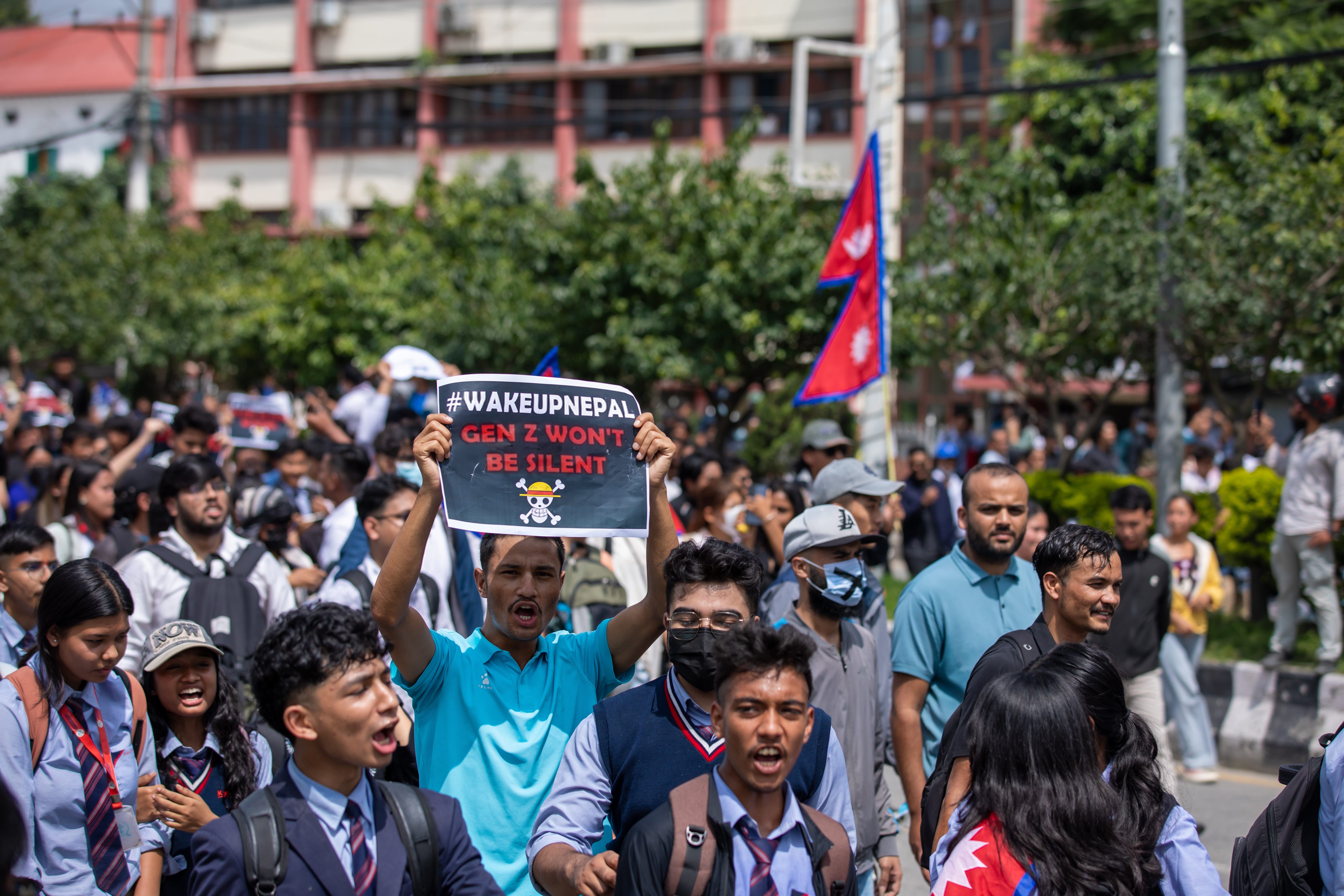
This rejection of a failed status quo is leading Gen Z abroad into action. In Nepal, young activists launched campaigns exposing the lavish lifestyles of political elites, using hashtags like #NepoKids. When the government responded by restricting online platforms, young people took to the streets. The protests ultimately forced the prime minister to resign, but also claimed the lives of several dozen people.
In Madagascar, inspired in part by events in Nepal, and fed up with power outages and infrastructure failures in one of the poorest countries in the world, young people mobilized both online and offline, forcing their prime minister from power. In Peru, youth protesters bravely marched during a state of emergency to oppose corruption. In Morocco, Gen Z erupted over unemployment and bleak economic prospects as the government spent lavishly preparing for the 2030 World Cup. And in Kenya, young protesters stormed Parliament to resist a finance bill they believed would further economic inequality and entrench corruption at their expense.
The list goes on—young people have also protested in Mexico, Bangladesh, Indonesia, Thailand, Bulgaria, and the Philippines. Their grievances vary, but the underlying message is remarkably consistent: institutions meant to govern young people’s lives have failed them. This surge in activism is less ideological than existential, rooted in skepticism that democracy, as currently practiced, delivers on its promises.
The long-term success of these movements remains uncertain. Online organizing has fueled mass mobilization and short-term wins, but durable change requires sustained organization and consolidated political power. As the aftermath of the Arab Spring demonstrated, dismantling entrenched systems is far easier than building something better in their place.
A Moment for Young People in the United States
While young Americans demonstrate similar frustrations compared to their international peers, it remains in question whether their institution distrust will lead to real action. To that end, meeting this moment in the United States presents a two-fold challenge.
First, political leaders across the spectrum must recognize that young people’s distrust of institutions is often justified, and does not map neatly onto ideology. Politicians should stop treating young people as an afterthought, and start treating them as potential co-architects of democratic renewal. Young people want action: an acknowledgement that liberal democracy has fallen short of its promises; economic policies that meet the moment; and leaders who are not part of a gerontocracy. It is not enough to lecture young people on the principles of democracy, or employ a staid civics education that teaches young people how government works. Political leaders must make room for new leadership, new ideas, and a generation that is impatient with a system that has asked them to wait indefinitely. Either political party in the United States could deliver the change that young people are clamoring for right now.
Second, there is a real risk that frustration among young people hardens into cynicism and a belief that nothing matters and politics cannot deliver meaningful results. Growing cynicism opens the door to inaction and to remaining on the sidelines. But more than that, it could lead to greater acceptance of violence, illiberalism, and the idea that authoritarianism might work better.
At the same time, Gen Z faces its own responsibility. Change will not come overnight. Democracy does not work on frustration alone or produce instant results. It requires participation, taking to the streets, organizing, and the slow, often unsatisfying work of building power that lasts longer than a protest cycle or a viral moment.
Young people are fed up. They are also uniquely positioned to decide whether this moment of global disillusionment leads to a democratic collapse or a democratic reset. The rest of us would be wise to stop bemoaning them and start building with them.
Scott Warren is a Fellow at the SNF Agora Institute at Johns Hopkins University. He is currently leading an initiative focused on exploring, researching, and convening a pro-democracy conservative agenda in the US, organizing convenings focused on bridging long-term and short-term fixes for democratic reform, and exploring ways the US can learn from global efforts to improve democracy (including helping to run Democracy Without Exception).
Well said, Scott! Your work in this field is inspiring. My two cents is that I believe we are failing to give youth effective training with the tools to effect change in their worlds big and small. These tools are varied: power tools to build, rhetorical tools to speak, computer tools to code, social tools to lead and convene, etc. Particularly in high school, we should be creating more opportunities for youth to be practicing the usage of these tools in scenarios that have real value to society. Our classrooms have become too insulated. No wonder youth turn more readily to digital existences where they have some amount of agency and value.
Can’t like this enough. As someone in that generational moment (Zillenial here) with strong convictions about Democracy, I’ve been digging at this for a while now. It’s not so much that “Democracy is broken” as “our democracy is broken.” I love that this piece makes that distinction.
Where I think it’s broken, primarily, is along the trust, legitimacy, and representation axes, and this has to do, as the article points out, with state power and overreach, misallocation of resources, economic malaise, and societal ruptures. They all play against and reinforce each other, and the same is true in reverse if we fix it. I’m convinced this is because of misaligned incentives—in representation (voting), in money (consequences of fiat currency), and the interplay of those two across most of government and society.
Thrilled to read this take, and looking forward to more thoughtful pieces like it!