
Transitional Justice at Home
David Mandel-Anthony on the Illinois Accountability Commission and democratic resilience
Last September, President Donald Trump threatened war against an American city. “I love the smell of deportations in the morning,” he posted alongside an image from the movie Apocalypse Now, warning Chicago it was “about to find out why it’s called the Department of WAR.” Many dismissed it as bluster. Residents of Chicago and the surrounding suburbs soon learned otherwise. In the months that followed, federal agents ostensibly conducting immigration enforcement actions swept through communities with violence and impunity, terrorizing residents and suppressing lawful dissent.
In late October, while the raids and violence were still ongoing, Governor J.B. Pritzker established the Illinois Accountability Commission (IAC). “We will not meet intimidation with fear—we will meet it with truth,” the governor declared. “We are going to show the public…exactly what is going on.” The governor’s Executive Order mandated that the IAC document and investigate abuses by federal agents, hold public hearings, create a factual record, examine community impacts, and recommend policy reforms.
The IAC is the first of a new kind of institution emerging in the United States: a sub-national accountability mechanism set up to address ongoing federal repression. It is comparable to transitional justice bodies developed in societies around the world to confront authoritarianism and violence, and lay the foundations for democratic accountability. These global experiences, and the IAC itself, offer valuable lessons for Americans standing up for democracy—especially at the state and local levels—about the promise of transitional justice as one tool to combat authoritarian overreach.
Accountability in real time
For nearly two decades, I worked as a transitional justice practitioner and diplomat, including at the U.S. State Department. I helped set up truth commissions, reparations programs, investigative bodies, and war crimes tribunals in countries such as The Gambia, Guatemala, Syria, Ukraine, Venezuela, and Myanmar.
Transitional justice has profoundly transformed societies and led to democratic progress. In Ukraine, prosecutors, assisted by international experts, have opened thousands of war crimes investigations, even while Russian attacks continue. In The Gambia, testimony before the national truth commission about abuses under a previous regime riveted the country and galvanized efforts to build a specialized war crimes tribunal. In Guatemala, post-conflict truth commissions laid the foundation for the prosecution—decades later—of a former president and other top-ranking political and military leaders. Such transitional justice initiatives are usually established at the international level or by national governments, rather than by state or local entities. They also address mass atrocities, authoritarianism, and violence at a scale not seen in the United States. Even so, when the IAC was created, I immediately recognized it as a transitional justice mechanism.
As the IAC launched, I advised its leadership on mandate design, hearings, documentation, evidence preservation, and impact. Alongside another former colleague with international expertise, I shared best practices for building legitimacy, analyzing patterns of abuse, and supporting accountability, reform, and truth-seeking.
The IAC moved quickly to appoint commissioners, hire staff, and begin operations. Chair Rubén Castillo and Vice Chair Patricia Holmes, both former judges, were assisted by six commissioners, including high profile legal professionals, community leaders, and a former police commander. A small staff, including several former investigators from the Department of Justice, drew up hearing schedules and investigative workplans. The IAC was housed within the state government (the Department of Human Rights), which offered immediate staffing and operational support. The reputational and relational cache of the Commissioners and staff helped the IAC quickly build legitimacy and trust with traumatized communities.
Still, the IAC needed to burnish its legitimacy as a non-partisan body mandated to establish an independent record of events—especially since it was created by a Democratic governor with a national profile. So it relied on non-partisan expert witnesses, invited Trump officials to provide their views (they declined), and called the former Republican statehouse leader as a witness to testify about threats to election integrity. The IAC demonstrated credibility and integrity through competence: conducting a transparent process, explaining how it gathered and evaluated evidence, and characterizing its legal findings in a clear and measured tone. As the Chair explained, “the record is substantial, corroborated across multiple sources, and developed through independent investigation.”
Within six weeks, the IAC held its first public hearings, and soon after convened private community listening sessions for residents too afraid to testify publicly. In six months, the IAC held five public hearings, seven listening sessions, issued an interim and final report, and conducted sixteen in-depth investigations into “egregious incidents.”
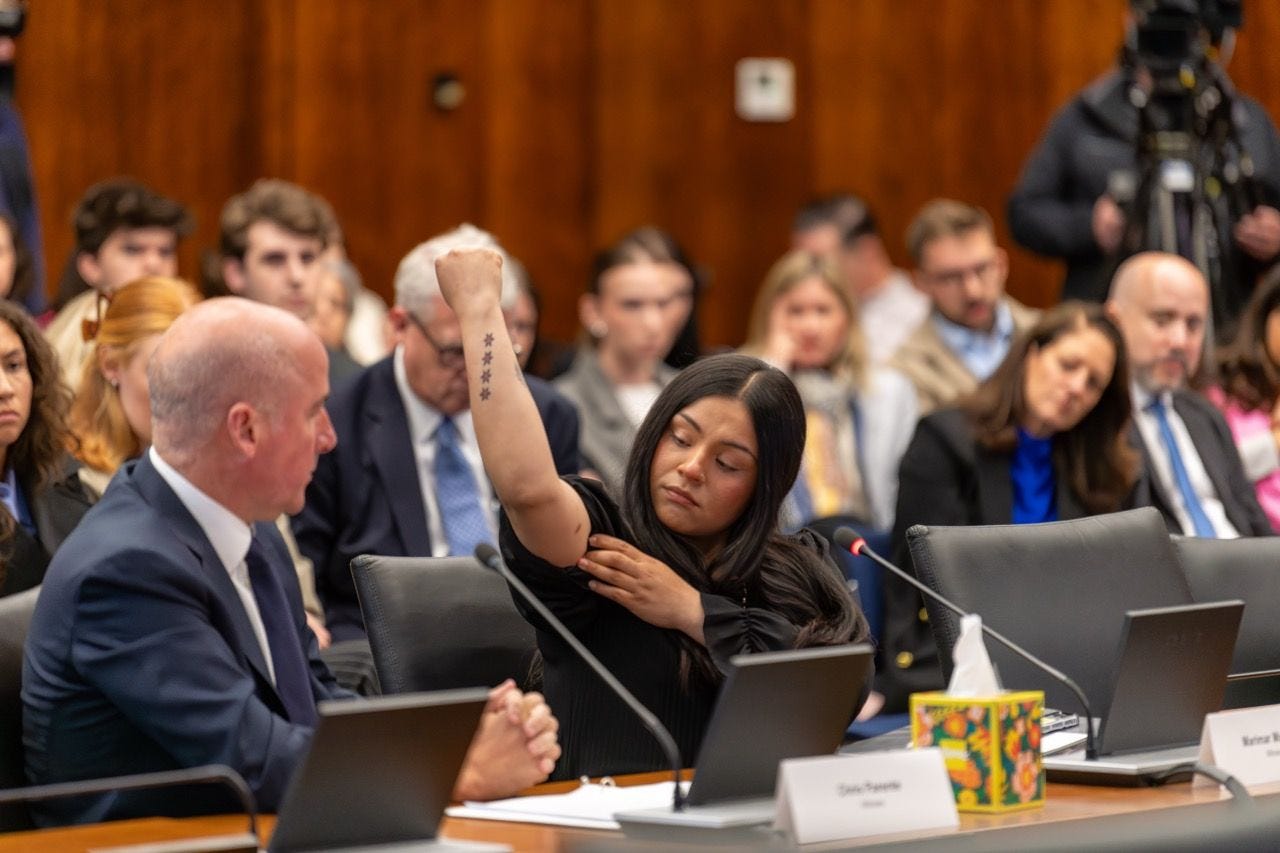
In late April, I attended the last of the Commission’s five public hearings in downtown Chicago. Witnesses described residents brutalized by federal agents for peacefully recording arrests or attempting to protect neighbors. Marimar Martinez testified that a Border Patrol agent intentionally rammed Martinez’s car—using a tactic previously restricted under earlier federal pursuit rules that were loosened under the Trump administration—before shooting her five times as she tried to drive away. At the hospital, agents arrested her under the Kafka-esque charge of assaulting an officer. The Commission later presented evidence suggesting the officer had repeatedly lied about the encounter and yet faced no consequences. Instead, Commander-at-Large Greg Bovino praised him for “excellent service” and offered to extend his retirement eligibility. Another witness described how communities resisted with “whistles and cellphones and their voices,” even as federal agents wielded guns and tear gas and enjoyed promises of immunity from senior administration officials.
From individual incidents to systems of repression
Throughout its proceedings and final report, the IAC documented systems of repression, institutional impunity, and responsibility reaching up the chain of command to the senior-most officials in the Trump Administration. The Commission highlighted propaganda campaigns by senior administration officials, attacks on freedom of expression and assembly, and the normalization of state violence in the name of public order. Commissioners warned that methods first used in Chicago to terrorize immigrant neighborhoods could be employed elsewhere to threaten political dissent and even free and fair elections.
The IAC outlined what it called three federal “directives”—the policies behind Operation Midway Blitz: militarize neighborhood streets, suppress lawful speech and assembly, and normalize immunity for lawlessness. These policies, the Commission concluded, made “Illinois a testing ground for a new model of federal power…so the President could invoke the Insurrection Act to occupy an American city.” The IAC referred incidents it investigated to state and local authorities, urging them to open criminal investigations and prosecute individual agents named in the report—although some prosecutors have resisted doing so.
The Commission issued nearly 80 recommendations to government officials and the private sector, ranging from stronger accountability mechanisms and ICE vetting standards, to support for affected communities and expanded state authority to prosecute abusive federal officers. It also highlighted Illinois laws and policies that had mitigated some harms of Operation Midway Blitz, recommending that other states consider these defenses “in anticipation of potential immigration enforcement surges.”
This is where transitional justice frameworks become useful for defending democracy: they don’t just document abuses, they also identify broader patterns of repression; elevate democratic resiliencies; and propose systemic reforms.
Bringing transitional justice home
While the IAC was the first official body at the subnational level to confront ongoing violent repression by the federal government, much more transitional justice work has taken place in the United States than is often recognized. A study by Howard University Law School identified more than 90 such initiatives in cities and states around the country, mostly addressing historical racial violence and discrimination against Blacks and Native Americans. These include, for instance, truth commissions in Maine and California focused on Native Americans, and the Lynching, Truth, and Reconciliation Commission in Maryland. Reparations initiatives and payments have been enacted in municipalities such as Amherst, Massachusetts and Rosewood, Florida.
The Chicago area, too, has transitional justice precursors to the IAC, including a 2015 law creating a public memorial and reparations for victims of police torture, and a reparations program in Evanston for victims of racial discrimination in housing policies.
These efforts across the country, however, remain fragmented and underdeveloped. Local leaders often lack practical guidance on designing commissions, conducting investigations, preserving evidence, and linking accountability efforts to democratic reform. International experience in transitional justice offers rich comparative practice and useful guidance. As commissions and investigators in the United States collect, authenticate, and share evidence of federal abuse across jurisdictions, they can benefit from practices, guidelines, and techniques honed by international investigative commissions for Syria, Myanmar, and South Sudan, and by the Ukrainian war crimes prosecutors.
The Illinois Accountability Commission offers a promising example of adapting comparative approaches to transitional justice. The broad scope of its recommendations resemble those of truth commissions around the world, ranging from referrals for criminal investigation, legal and institutional reforms, and reparations for economic harm suffered by small immigrant businesses, to longer-term efforts to restore trust between residents and democratic institutions.
The IAC also faced real constraints, including a short timeline and lack of power to subpoena and prosecute. Perhaps the most consequential limitation was one out of its control: the reality that the federal executive branch has no interest in holding itself accountable. In the face of federal impunity, the IAC asserted the accountability prerogative at the state level—creating a public record, preserving testimony and evidence, and connecting the responsibility for abuses on the ground to political and law enforcement leaders. Crucially, the Commission provided a forum for ordinary people to describe both abuses and acts of courage, resistance, and solidarity.
These are forms of democratic defense and an assertion of state power in a federalist system. Democracy defenders in the United States—from neighborhood ICE watch groups to philanthropies—should pay close attention. In anti-authoritarian struggles, resistance can be contagious, and institutions like the IAC grow the muscles of democratic power.
Toward a network of subnational accountability institutions
Already, other states are following suit. In March, Governor Tim Walz established a “Truth Council” to document federal enforcement operations in Minnesota, supported by Advocates for Human Rights, a Minneapolis-based organization with decades of transitional justice expertise. In Los Angeles, Mayor Karen Bass held hearings about ICE abuses, and there are discussions about creating a more formal response.
Future accountability initiatives should be linked across states and cities, designed to move evidence, investigative methods, perpetrator dossiers, and resistance lessons across jurisdictions—just as easily as (now former) ICE Commander-at-Large Greg Bovino moved from Los Angeles to Chicago to Minneapolis.
These bodies can also connect to international justice and human rights networks to share evidence, techniques, and forums for spotlighting federal abuse (a group of United Nations human rights rapporteurs has engaged with the Minnesota Truth Council). To combat perceptions that these bodies are partisan exercises, legislatures and city councils, rather than executives, could create the mandates, appoint diverse political representation, and seek the support of good government groups across the political spectrum.
Civic organizations, philanthropies, and national democracy groups can provide connective tissue to support domestic transitional justice through funding, investigative capacity, community support, and specialized expertise. The support required goes far beyond importing “lessons learned” from abroad; crucially, communities and subnational leaders need help accumulating the tools, resources, transnational alliances, and institutional knowledge to build accountability structures here at home.
Other societies have spent decades developing methods to confront authoritarianism and democratic breakdown, and the United States is not exempt from those patterns. In that sense, the Illinois Accountability Commission was more than an investigation into abuses in Chicago. It was an early experiment in democratic resilience rooted in global traditions of accountability, truth-telling, and justice.
David G. Mandel-Anthony is an independent consultant, strategist, and foreign policy expert. He sits on several advisory boards, including of the Auschwitz Institute for the Prevention of Genocide. From 2012 to 2025 he served in the Office of Global Criminal Justice in the U.S. Department of State, including as Deputy to the Ambassador-at-Large.
Illinois's Commission is reminiscent of the way the International Criminal Court's hearings operate in The Hague after violence against innocent citizens. Bravo to Governor Pritzger in acting so quickly to set it up, and may other states follow his example.