

Coalitions That Endure
What Americans can learn from movements abroad

For the past few months, I’ve been studying what allows broad pro-democracy coalitions to form and last, as part of a project on global democratic change. I’ve talked with many organizers and advocates from Bangladesh, Kenya, Nigeria, Poland, Serbia, South Korea, and Turkey—countries that have recently seen mass protests capable of checking or even toppling those in power—about what strengthens coalitions, what fractures them, and what sustains democratic energy once the moment of protest passes.
Given the events unfolding in the United States, these activists are watching the country closely. As Aysha Sidiqqua, a student organizer from Bangladesh, told me: “Courage is contagious. When one group stands up, others follow.” They speak from experience: each activist has lived through attempts to weaken institutions, divide societies, and erode the rule of law. They have learned, often through painful trial and error, what it takes to build coalitions that not only mobilize, but survive victories, defeats, and the long arc of change.
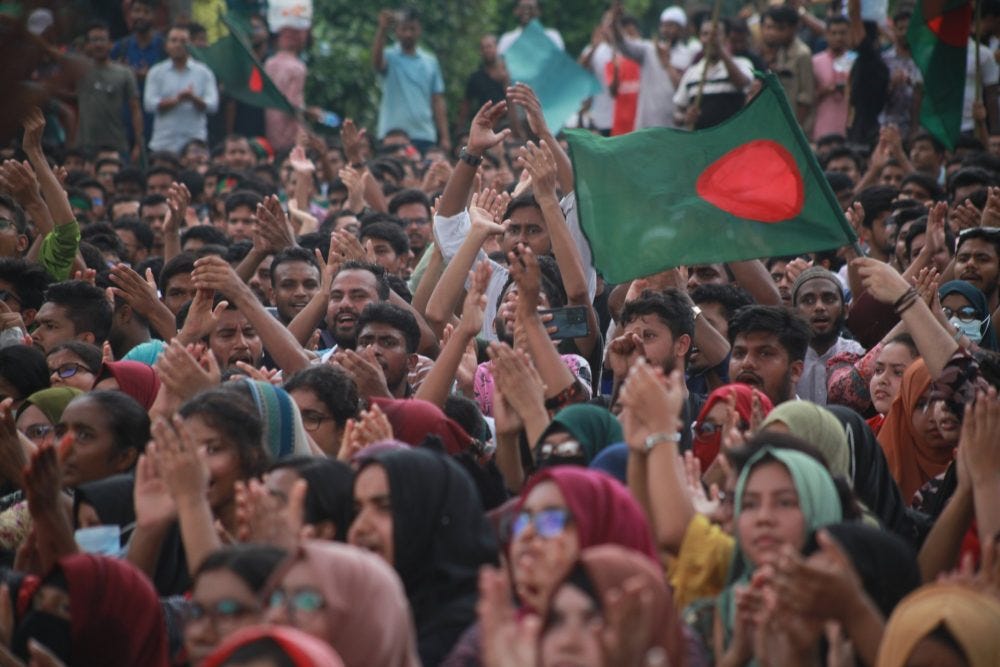
Two main lessons emerged from these conversations that are relevant for U.S. democracy funders, practitioners, and organizers, at a moment when broad-based coalitions are seen as vital to safeguarding U.S. democracy and interest is growing in what other countries’ successes and missteps can teach.
First, It’s Not Just About Winning—It’s About Surviving the Win
Nearly every activist I spoke with emphasized the same point: broad coalitions can be powerful for stopping an autocratic leader or undemocratic reform, but they rarely hold together for long. The challenge is not just to win a battle, but to sustain the unity and capacity needed for the coalition to deliver the change it set out to achieve.
Uğur Özdemir, a Turkish political scientist, stressed that winning an election is only the first stage. Effective coalitions, he argued, need multi-step strategies: how to regroup after setbacks, how to manage transitions, and how to govern once in power. Movements need to prepare for both wins and losses.
Several activists argued that coalitions should delay divisive ideological debates—such as secular versus religious visions of the state, gradual versus radical reforms, or identity-based versus issue-based platforms—until after they’ve secured their immediate goal, be it an election win or forcing a rollback of repressive legislation. In other words, “agree to disagree later” rather than splintering beforehand.
But postponement only goes so far. Turkey’s 2023 elections offer a cautionary tale. Opposition party leaders united across ideological lines to challenge President Erdoğan, but many ordinary voters would not cross the same divides. Secular voters were asked to back Islamists and left-leaning voters to support conservatives—compromises many saw as untenable. The “super coalition” that aimed to bring everyone under one tent collapsed quickly after its electoral defeat. Even if they gain power, big tent platforms often unravel, as the widening fractures within Bangladesh’s victorious multi-party coalition demonstrate.
A lesson Turkish organizers drew is that electoral coalitions gain credibility when they exclude extremes, and civic coalitions grow when they avoid foregrounding polarizing figures—choosing instead to unite around shared, practical goals.
These examples underscore a broader lesson: opposition alone is not a strategy. Uniting against a common threat—whether an autocratic leader (Bangladesh, South Korea, Turkey), an attack on judicial independence (Poland), unpopular tax legislation (Kenya), or failed governance (Nigeria, Serbia)—can spark a movement. But sustaining that movement requires a shared picture of the future. As Nigerian activist Raphael Adebayo told me, unless movements offer a “people-centered democratic vision of the future” that speaks to the root causes of popular frustrations, the protest energy quickly evaporates. Serbia’s experience illustrates this: in the early-2000s, students didn’t just call for Milošević’s removal, they imagined a country with free universities, independent media, and “where IKEA could open and the Rolling Stones could play,” recalls Breza Raće of the nonviolent resistance organization CANVAS. It was that hopeful vision that kept the movement alive.
But the vision needs to be paired with a realistic plan for how to achieve it. The broad coalition that brought President Milošević down dissolved soon after, leaving many of those aspirations unmet. Some Serbian activists describe current mobilizations as unfinished business stemming from that moment, and say the earlier coalition should have remained together to support—and hold accountable—the new government as it pursued reforms. Similarly, Özdemir’s research shows that Turkish swing voters —young, educated, and anxious about the future—are weary of politicians’ vague, utopian promises. They want practical steps and believable pathways toward a better future, not slogans. Yet in a landscape of politicized courts, captured media, and a civil service stacked with loyalists, even a victorious Turkish opposition would struggle to govern. This frustration echoes across many contexts, reflecting a broader disillusionment with politics that overpromises and underdelivers.
All of this leads to a core question: how do you build a shared vision for the future in deeply divided and polarized countries? Özdemir noted that in Turkey, deep ideological divides over religion and nationalism make consensus especially hard; one way forward, he suggested, is to anchor the conversation in what kind of country people want to leave to their children. Kenyan and Nigerian activists added another imperative: give people real agency in shaping that vision.
Second, Don’t Just Mobilize Civil Society, Win Over Society
Protests matter. They build solidarity, shift the public mood, and signal that people are not afraid. But protests alone don’t shift power. Enduring change happens when entire sectors of society join the effort.
Interviewees stressed that this requires engaging social pillars: teachers and school networks, health workers and unions, business associations, faith communities, student groups, and artists and cultural institutions. When these sectors participate, the movement becomes a broad public demand, not just an activist cause. This is why movements must expand beyond their base and bring in “neutral” or weakly loyal institutions.
In Serbia and Poland, coalitions only gained real momentum once teachers, health workers, IT professionals, and Church-linked groups stepped in. As Raće put it: “Change doesn’t happen because of protests alone. It happens when schools, clinics, and businesses join in.”
Engaging broad parts of society also protects against becoming partisan. Most interviewees advised maintaining working relationships with political parties—many of which joined protests in solidarity—but cautioned against endorsing them. The power of movements lies in setting the agenda, without being bound by one party’s priorities.
Poland offers an instructive example. With the political opposition deeply fragmented, civil society stepped in as a trusted convener. It brought together teachers’ unions, parents’ associations, local officials, business leaders, and even Church-affiliated groups to articulate a common agenda on issues ranging from human rights to the environment to education. A major win for the cross-sector alliance was stopping the authoritarian-leaning Law and Justice Party from interfering in schools, forcing a presidential veto by a president from that party.
Interviews also revealed a tension: some organizers see engaging these social pillars as essential, while others—especially from social movements—are more wary of institutions that may be co-opted and instead prioritize mobilizing individuals. Yet despite these differences, everyone agreed on one point: the importance of local, neighborhood-level organizing that grounds coalitions in everyday life.
Coalitions capable of this kind of broad engagement are decentralized, flexible, and rooted in local realities. For example:
In Poland, civil society formed multiple parallel coalitions—on education, rule of law, and climate—to counter the Law and Justice party’s “salami tactic” of isolating each sector one slice at a time, as human rights defender Ewa Kulik-Bielińska put it.
In Serbia, locally-based organizing made movements both harder to repress and more rooted in everyday realities, tying their demands to the “bread and butter” issues people care about rather than to abstract human rights concepts.
In South Korea, when martial law was declared in late 2024, national hubs helped coordinate local coalitions using longstanding networks like labor unions and faith groups to rapidly mobilize, according to Mihyeon Lee of solidarity network PSPD.
In Kenya, Chris Muriithi, founder of Bold Network Africa, found that inviting people to join coalitions as individuals—rather than as representatives of specific groups—made coalitions more flexible and welcoming, avoiding the exclusion that identity-based structures can create. Bold Network Africa models this through a “leaderless” structure with rotating leadership and collective agenda-setting.
Across these contexts, youth were central. In Bangladesh, Kenya, Nigeria, and Serbia, students and Gen Z drove mass mobilizations, sustaining protests with digital organizing and culturally resonant messaging. In Kenya, where 75% of the population is under 35, youth activists cast themselves as “the real opposition,” pressing political elites to respond to their priorities. In South Korea, K-pop songs, costumes, and light sticks made participation feel cool, as youth activist Sohee Yang observed. Young people are not only protesting the abuse of power—they are preparing to exercise it, building candidate pipelines, training new leaders, and forming new political platforms, from Bangladesh’s youth-led National Citizen Party to VALID, a South Korean political think tank for emerging leaders, to a student-run electoral list in Serbia.
The Hard Work Ahead for American Democracy
For U.S. funders and organizers, the takeaways are to invest less in discrete events like elections and more in civic infrastructure (the organizations and networks that keep people engaged); support coalitions built to last; and build alliances that reach the whole of society. The No Kings protests signaled widespread frustration with Trump and his policies, but protest alone will not halt or reverse democratic backsliding. The opposition—political and civic—needs to articulate a shared vision for the future and a credible plan for getting there, a task made harder in a country as polarized as the United States. It also needs to engage key sectors of society and mobilize Americans where they live, work, learn, and worship, in order to build the long-term power required to win and implement changes that address people’s real concerns and expectations.
People around the world who have fought—and are still fighting—for democracy are watching the United States and share a common hope: that the American public will rise to this moment, push back, and prevail.
Soheila Comninos is a consultant with the SNF Agora Institute at Johns Hopkins University and a non-resident fellow at Accountability Lab. She previously led global human rights portfolios at the Open Society Foundations and served with the International Committee of the Red Cross in conflict-affected countries across Africa and the Middle East.
The author is grateful to the organizers and advocates in Bangladesh, Kenya, Nigeria, Poland, Serbia, South Korea, and Turkey who generously shared their time, experience, and hard-won lessons for this piece.
 | A guest post by
|